★ ISA-Certified Arborists · Serving Waukesha & Milwaukee County
★ ISA-Certified Arborists · Serving Waukesha & Milwaukee County
By Chris Dunbar, Dunbar Tree Service
Managing ice and snow hazards is critical to safety and long-term tree health across Wisconsin. This guide summarizes prevention, assessment, and recovery steps property owners and managers can use, and explains how ISA Certified Arborists support winter tree safety.
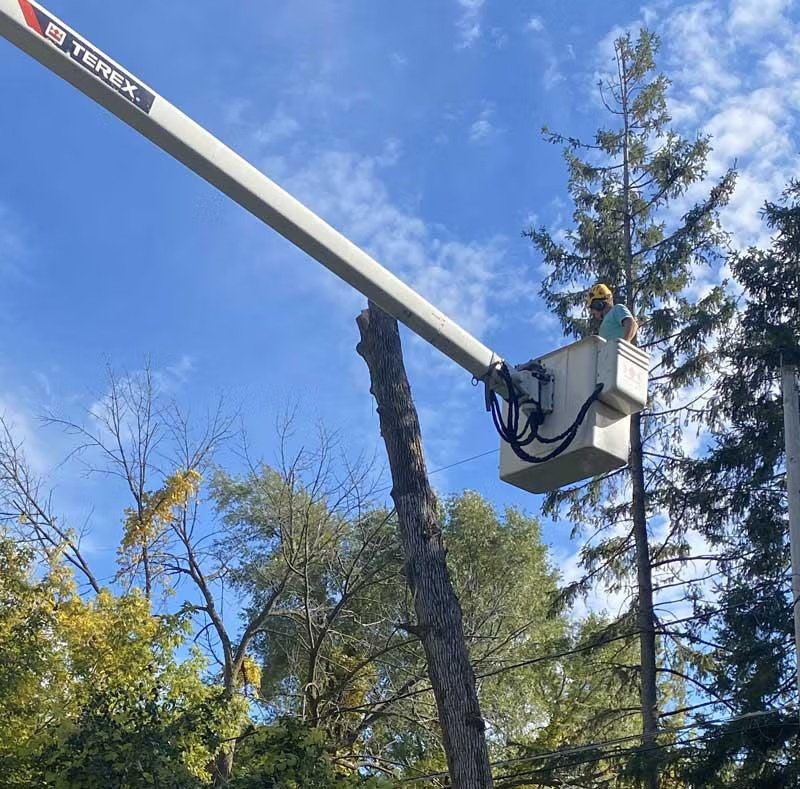
Schedule routine structural inspections, corrective pruning, and support-system installation where needed to reduce snow and ice retention and improve a tree’s ability to shed load.
Dunbar Tree Service offers certified structural pruning and hazard mitigation, delivering assessments and recommendations to strengthen trees before winter storms. Learn more about their offerings at the Dunbar Tree Service Winter Services page.
Use a methodical inspection to classify damage (minor versus major) and determine remediation. Look for snapped limbs, trunk fissures, and changes in posture such as new lean.
If damage threatens people or property, coordinate an emergency response for stabilization or removal; trained crews can secure sites and prevent cascading failures.
Heavy snowfall and ice accretion increase bending moments on crowns and limbs, producing snaps, splits, and progressive structural compromise. Wind loading adds dynamic forces that magnify risk.
Snow and ice add static and dynamic weight that can exceed a limb’s capacity, especially where wood is weakened or diseased, reducing vigor and raising vulnerability to pests and decay.
Research analyzes species traits and site conditions that drive branch failure under snow loads and highlights factors affecting vulnerability.
Snowstorm Branch Failure Factors & Urban Tree Selection
Probability of branch failure differed among species. It also increased with greater DBH in eight of ten species studied, decreased when defects were present in four of ten species, and increased in one species when leaves were present. The relationship between branch failure and DBH appeared to be due to the correlation between DBH and branch morphology, which was mostly similar among species. As DBH increased, so did the mean diameter and length of primary branches, and the cumulative diameter of secondary branches. In contrast, branch slenderness decreased with increasing DBH. Combined, these factors presumably expedited the accumulation of snow on branches due to greater surface area and less flexibility. This explained why most failed branches were not defective. Since the frequency of intense storms is predicted to increase with global climate change, urban foresters should consider the timing of leaf senescence when selecting deciduous trees, to reduce the likelihood of failure of open-grown, deciduous trees in urbanized areas.
Factors affecting branch failures in open-grown trees during a snowstorm in Massachusetts,
USA, B Kane, 2014
Typical failures are broken branches, trunk cracking, and leaning trees; each requires a distinct inspection and corrective approach to manage safety and structure.
Early identification enables targeted interventions to reduce risk and support recovery.
Ice storms carry economic and public-safety impacts; planners should assess species susceptibility when managing urban tree populations.
Ice Storm Damage & Resistant Urban Tree Populations
Severe ice storms occur every year in the United States and Canada, particularly in the midwestern and eastern regions of the United States. Along with fires and wind, ice storms are a frequent and major natural disturbance factor in eastern deciduous forests. Likewise ice storms are responsible for deaths and injuries of people and cause dramatic damage and tree loss to urban forests. Ice storms annually result in millions of dollars in loss, and potentially billions of dollars in losses for extreme and widespread ice storms. Damage to electric distribution systems, blocked roadways, and property damage from fallen trees and limbs pose safety concerns and disrupt normal community functions. Tree species vary in their resistance to ice accumulation. Certain characteristics, such as weak branch junctures indicated by included bark, dead and decaying branches, a broad crown, and fine branching, increase a tree’s susceptibility to ice storm damage.
Trees and ice storms: The development of ice storm–resistant urban tree populations, RJ Hauer, 2006
Pruning modifies crown form and removes defective wood so the crown sheds snow more easily. Crown thinning and deadwood removal redistribute loads and reduce predictable failure points.
Key techniques: crown thinning to lower surface area, deadwood removal to eliminate weak elements, and timing work before dormancy to minimise stress.
Follow arboricultural standards when applying these techniques to improve resilience.
Post-storm pruning removes damaged limbs that invite decay, restores structural balance with correct cuts, and supports regrowth and long-term recovery.
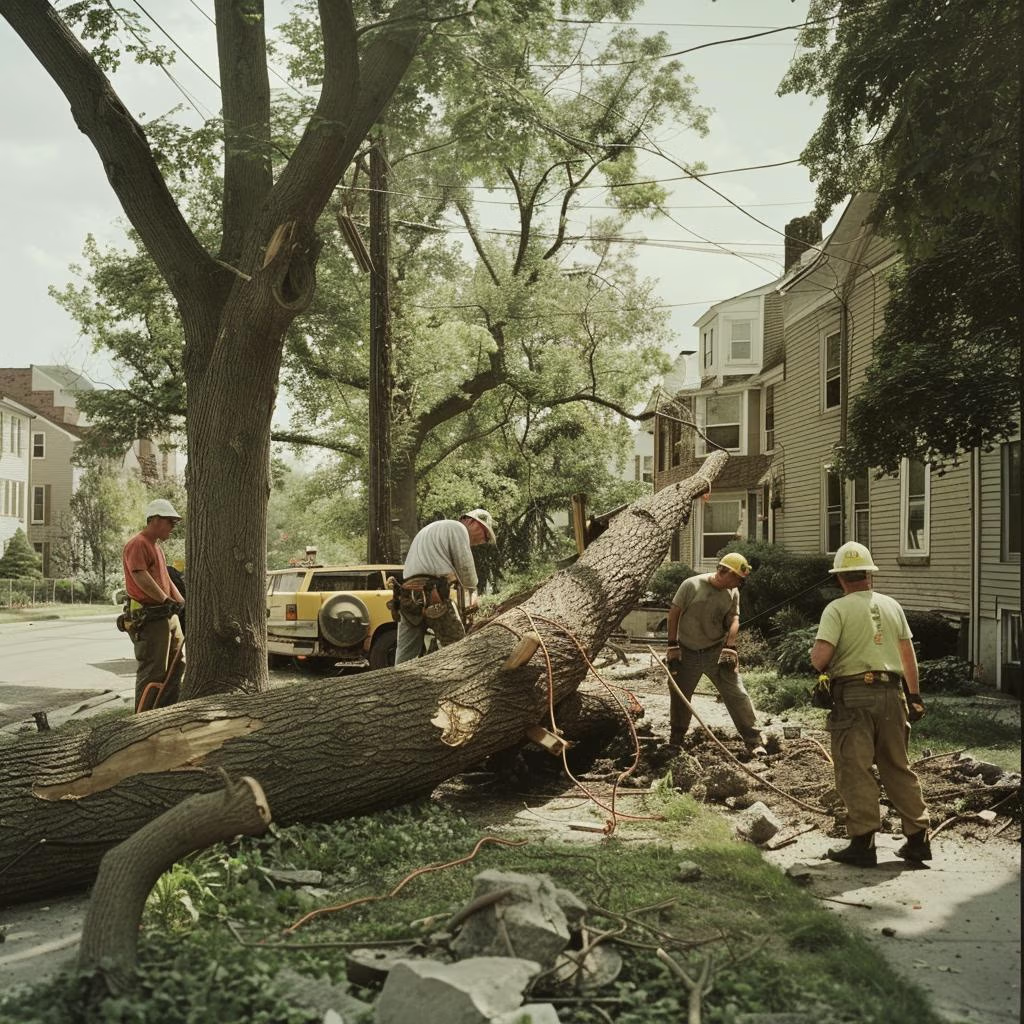
Engage emergency removal for imminent hazards such as large broken limbs, pronounced leaning, or visible trunk fissures to reduce risk to people, utilities, and structures.
Quick intervention secures the site and prevents cascading failures.
Signs include severe leaning (notably beyond normal tilt), conspicuous trunk or major branch cracks, and large suspended limbs that are unstable; these indicate high failure probability and call for professional action.
Recognising these signs helps decide between removal and mitigation.
Dunbar maintains trained emergency crews that follow safety protocols, mobilise rapidly, and use appropriate equipment to remove or stabilise hazardous trees safely and efficiently.
Homeowners lower winter risk with regular inspections, seasonal professional pruning, and support systems for high‑risk trees.
Consistent application of these measures reduces the chance of structural failure during severe winter events.
Routine assessments find defects and vulnerabilities early so corrective pruning, bracing, or removal can be completed before winter, lowering storm-failure probability and liability.
ISA Certified Arborists bring validated expertise in tree biology and structural assessment; their training supports evidence-based management plans for winter risk reduction.
Certified arborists use standardised risk-assessment methods and diagnostics to inform safe, evidence-based tree management decisions.
Professional Tree Risk Assessment Methods
Experienced arborists can aid in this decision process by conducting a professional risk assessment that specifies the likelihood of whole or partial tree failure, the consequences of such a failure, and the potential targets affected. A variety of risk assessment methods have been developed to guide professionals through the tree inspection process. In North America, three risk assessment methods have gained the greatest acceptance among tree care professionals, municipal urban forestry programs, and government agencies.
Tree risk assessment methods: A comparison of three common evaluation forms: ENH1226/EP487, 11/2013, AK Koeser, 2013
Late winter to early spring (just before bud break) is best for structural pruning; avoid heavy late-autumn pruning that stimulates vulnerable growth.
Look for cracks, deadwood, included bark at junctions, thin or poorly attached limbs, crossing branches, and narrow branch angles; consult a pro when unsure.
Do not strike or shake branches. Monitor for bending, splits, or cracks and call a qualified arborist if structural failure is suspected.
Species with strong branch attachments and flexible limbs (for example many oaks and some maples) tend to perform better than species with fine branching or included bark.
Long-term effects include chronic structural weakness, greater pest and pathogen risk, reduced vigor, and altered growth; untreated damage can necessitate removal.
Cables and braces redistribute loads and stabilise weak attachments when designed and installed professionally so they do not harm the tree.
Conduct a systematic assessment; arrange emergency removal for severe compromise; for salvageable trees, perform corrective pruning, monitor for disease, and schedule follow-ups.
Chris Dunbar is a certified arborist with decades of experience in tree care and management. He leads Dunbar Tree Service, providing expert advice and professional services to protect and maintain healthy trees in Wisconsin. Learn more about the team and their commitment to quality at the Dunbar Tree Service About Us page.