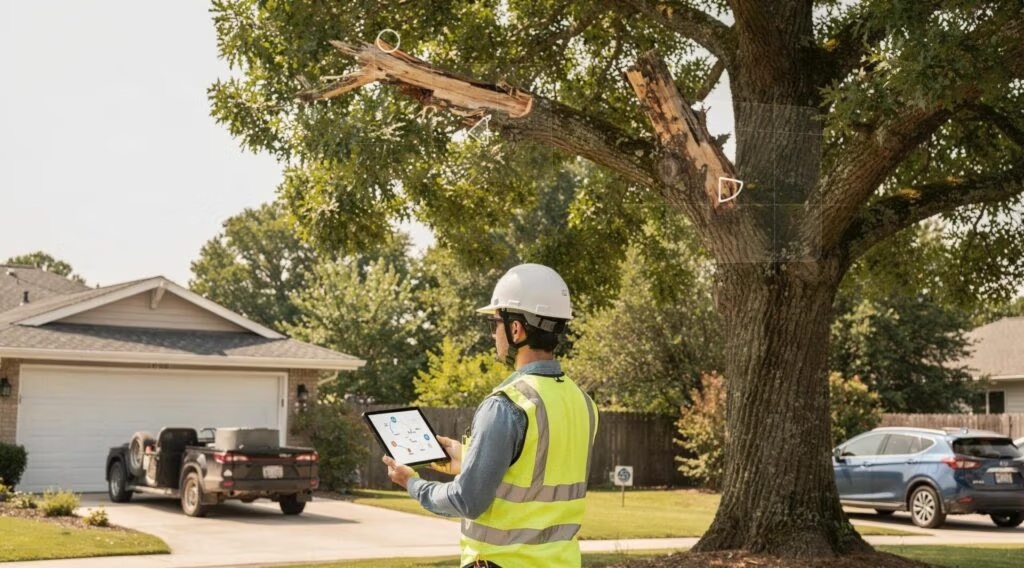
Tree health risk assessments are critical for maintaining the safety and longevity of trees in both residential and commercial settings. These assessments involve a thorough evaluation of tree health, identifying potential hazards, and implementing risk mitigation strategies. Understanding the importance of tree health risk assessments can help property owners make informed decisions that protect their investments and ensure safety. This article will explore the concept of tree health risk assessments, the role of certified arborists, and the processes involved in evaluating tree health. Additionally, we will discuss how Dunbar Tree Service can assist in these evaluations, providing expert insights and services.
A tree health risk assessment is a systematic process that evaluates the condition of trees to identify potential hazards they may pose to people and property. This assessment is essential because it helps prevent accidents caused by falling branches or entire trees, which can lead to significant damage and injury. By proactively identifying risks, property owners can take necessary actions to mitigate these hazards, ensuring a safer environment. Regular assessments also contribute to the overall health and longevity of trees, promoting sustainable landscaping practices.
The importance of a systematic approach to tree risk assessment and management is further emphasized by research highlighting the potential for tree failures to impact property and public safety.
Tree Risk Assessment & Management: A Systematic Approach
In the presence of a target, tree failures have the potential to damage property, disrupt services, or threaten public safety. Worldwide, several qualitative methods have been developed to provide a systematic approach for tree risk assessment and management. The consistency and accuracy of these methods, the values placed on the tree in question and its potential targets, and the risk perceptions and levels of acceptance of the evaluator and tree owner all influence how risk is managed. This review explores the concept of risk, examines and contrasts the most commonly referenced tree risk assessment methods, and summarizes research on public perceptions of trees and the risk of trees and greenspaces in built environments.
Risk assessment and risk perception of trees: A review of literature relating to arboriculture and urban forestry, RW Klein, 2019
Tree risk inspection services encompass a range of evaluations performed by certified arborists to assess the health and stability of trees. These services are crucial for timely interventions that can prevent accidents and property damage. Inspections typically include visual assessments, structural evaluations, and health checks to identify any signs of disease or decay. By understanding the importance of these inspections, property owners can prioritize tree care and maintenance, ultimately safeguarding their properties and enhancing the aesthetic value of their landscapes.
Tree hazard assessments play a vital role in protecting both homeowners and commercial properties. By identifying risks posed by trees, these assessments provide detailed reports that inform property owners about necessary actions to mitigate hazards. Collaborating with tree care professionals ensures that appropriate measures are taken, such as pruning, cabling, or even removal of hazardous trees. This proactive approach not only enhances safety but also preserves the beauty and integrity of the landscape.
The critical role of professional arborists in conducting these assessments, utilizing various established methods, is well-documented in arboricultural literature.
Professional Tree Risk Assessment Methods & Arborist Role
All trees pose some level of risk to nearby people, structures, and utilities. As trees age or become weakened by pests, disease, and/or other stresses, a tree owner or manager may need to decide what risk level he or she is willing to accept and what modifications may be needed. Experienced arborists can aid in this decision process by conducting a professional risk assessment that specifies the likelihood of whole or partial tree failure, the consequences of such a failure, and the potential targets affected. A variety of risk assessment methods have been developed to guide professionals through the tree inspection process. In North America, three risk assessment methods have gained the greatest acceptance among tree care professionals, municipal urban forestry programs, and government agencies.
Tree risk assessment methods: A comparison of three common evaluation forms: ENH1226/EP487, 11/2013, AK Koeser, 2013
Dunbar Tree Service specializes in providing comprehensive tree health risk assessments, ensuring that property owners receive expert guidance and support in managing their trees effectively. Our certified arborists are equipped with the knowledge and tools necessary to conduct thorough evaluations and recommend appropriate risk mitigation strategies.
An ISA Certified Arborist is a professional who has demonstrated a high level of knowledge and expertise in tree care and management. To achieve this certification, individuals must pass a comprehensive exam that covers various aspects of arboriculture, including tree biology, diagnosis, and treatment of tree diseases, and safety practices. This certification is essential for ensuring that tree evaluations are conducted by qualified professionals who adhere to industry standards and best practices.
ISA certification is a recognized credential that signifies a commitment to professional development and adherence to industry standards in tree care. Certified arborists are required to engage in ongoing education to maintain their certification, ensuring they stay updated on the latest research and techniques in arboriculture. This commitment to continuous learning enhances the quality of tree evaluations and risk assessments, providing property owners with confidence in the services they receive.
Choosing a certified arborist for tree evaluations is crucial for obtaining accurate risk analyses. Certified arborists possess the expertise to identify subtle signs of tree health issues that may go unnoticed by untrained individuals. Their knowledge of tree biology and structural integrity allows them to provide reliable assessments and recommendations. Additionally, certified arborists adhere to safety standards and best practices, ensuring that evaluations are conducted safely and effectively.
The tree risk evaluation process involves several key steps to ensure a comprehensive assessment of tree health and stability.
This structured approach ensures that all aspects of tree health are considered, leading to informed decision-making for property owners.
Professional tree inspections follow a systematic approach to ensure thorough evaluations. The steps typically include:
These procedures are essential for providing a comprehensive understanding of tree health and safety.
Identifying tree health indicators and structural defects is a critical component of tree risk assessments. Arborists look for various signs that may indicate underlying issues, such as:
Recognizing these indicators allows arborists to make informed recommendations for tree care and management.
Tree hazards are identified and assessed through a combination of visual inspections and diagnostic tools. Regular inspections are essential for monitoring tree conditions and identifying potential risks. Arborists utilize various techniques, including:
This comprehensive approach to hazard identification is crucial for maintaining tree health and safety.
Advanced diagnostic tools, such as tomography techniques, are crucial for detecting internal decay and hidden structural weaknesses, as detailed in specialized studies.
Tree Decay Detection: Tomography Techniques for Arborists
This paper reports application of electric, ultrasonic, and georadar tomography for detection of decay in trees and their comparison with the traditional penetrometer. Their feasibility in arboriculture is also evaluated, critically considering some “open problems.” The experiments were carried out in an urban environment on two plane(Platanus hybridaBrot.) trees. Both trees, after felling, showed extensive white rot in the central cylinder. The electric tomography revealed low resistivity zones roughly centered in the trunk. A comparison with the successively cut sections showed a fine correspondence to decayed areas and a strong correspondence between high moisture zones and low resistivity zones. Ultrasonic tomography demonstrated to be a very effective tool for the detection of internal decay, accurately locating the position of the anomalies and estimating their size, shape, and characteristic in terms of mechanical properties.
Application and comparison of three tomographic techniques for detection of decay in trees, LV Socco, 2003
In Waukesha and Milwaukee Counties, several common tree defects and risk factors can impact tree health. These include:
Understanding these local risk factors allows property owners to take proactive measures to protect their trees.
Classifying and prioritizing tree hazards is essential for effective risk management. Arborists utilize industry standards, such as those set by the International Society of Arboriculture (ISA), to assess and categorize hazards based on their severity and potential impact. This classification helps property owners prioritize necessary actions, ensuring that the most critical risks are addressed promptly.
Effective risk mitigation strategies following a tree health risk assessment can significantly enhance safety and tree longevity. Some recommended strategies include:
These strategies contribute to a proactive approach to tree management, ensuring that risks are minimized.
Implementing recommended safety measures and tree care interventions is crucial for maintaining tree health and safety. Key interventions include:
These measures are essential for effective tree management and risk reduction.
Proactive tree health and safety evaluations offer numerous benefits for property owners. These evaluations help:
By prioritizing proactive evaluations, property owners can ensure the safety and vitality of their trees.
The cost of a professional tree inspection can vary based on several factors, including the size and condition of the tree, the complexity of the assessment, and the location. On average, property owners can expect to pay between $100 and $300 for a comprehensive tree health risk assessment. Scheduling an inspection is straightforward; interested individuals can contact Dunbar Tree Service to arrange a convenient time for an evaluation.
Several factors influence the pricing of tree risk inspection services, including:
Understanding these factors can help property owners budget for necessary tree care services.
For certified arborist evaluations, property owners can easily contact Dunbar Tree Service. Our team is dedicated to providing expert tree health assessments and risk mitigation strategies. Interested individuals can reach us via phone at 262-271-0189 or email at trees@dunbartreeservice.com. Our office is located at 1013 Anoka Avenue, Waukesha, WI 53186. We look forward to assisting you with your tree health needs.
For more detailed tree diagnosis services, please visit our Tree Diagnosis page to learn how we can help identify and treat your tree health concerns with expert care.
tree risk assessment services