★ ISA-Certified Arborists · Serving Waukesha & Milwaukee County
★ ISA-Certified Arborists · Serving Waukesha & Milwaukee County
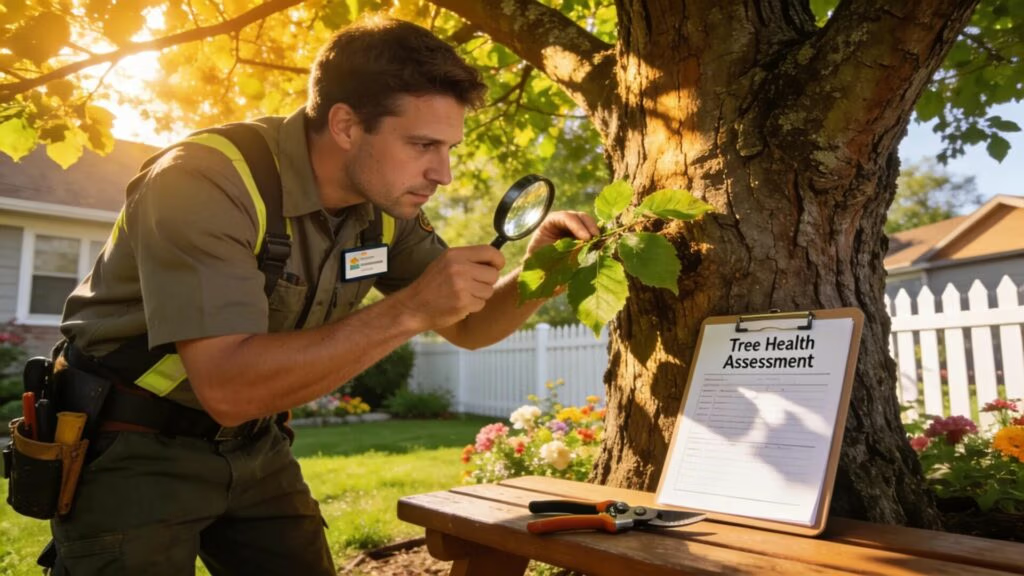
By Chris Dunbar, Owner of Dunbar Tree Service
Tree health assessments provide homeowners in Waukesha County with diagnostic information on tree condition, including identification of hazards and pathological issues that affect property safety and curb appeal. This document describes the scope and methodology of “comprehensive tree care“ evaluations and explains how assessment outcomes support evidence-based decisions for tree management and asset preservation. The subsequent sections outline the elements of a typical assessment, the evaluation process, and the rationale for professional tree care on residential property.
A tree health assessment is a structured evaluation performed by certified arboricultural professionals to determine a tree’s vitality and structural integrity. The assessment identifies pathogens, pest activity, abiotic stressors, and mechanical defects that may compromise tree performance or create hazards. For Waukesha homeowners, these evaluations support risk mitigation, protect property assets, and inform maintenance strategies that preserve landscape value.
Industry literature indicates that systematic evaluation is a critical component of effective tree management and risk mitigation.
Understanding Tree Risk Assessment: Protecting Property and Public Safety When a target is present, tree failure poses a potential risk of property damage, service disruption, or threats to public safety. Globally, various qualitative methodologies have been developed to provide a systematic framework for tree risk assessment and management. Risk assessment and risk perception of trees: A review of literature relating to arboriculture and urban forestry, RW Klein, 2019
Core components of a tree health assessment typically comprise a visual structural inspection, foliar and bark condition assessment, evaluation of root and soil conditions, and review of surrounding site factors. Combined, these elements produce a diagnostic profile that informs recommendations for treatment, mitigation, or removal where required.
Regular tree health assessments deliver measurable benefits: they maintain aesthetic and ecological value, reduce the probability of tree failure and associated property damage, and enable early, cost-effective interventions that limit escalation to more intensive treatments or removals.

Comprehensive tree care evaluations conducted in Waukesha County assess a set of factors that collectively determine tree health and risk profile. These assessments prioritize objective observation and data collection to produce a complete condition record.
These assessment elements ensure that practitioners can develop targeted management strategies aligned to the biological and structural needs of each tree.
Arboricultural professionals employ standardised, data-driven methods to assess stability and predict potential failure mechanisms for trees located on residential properties.
The Necessity of Professional Tree Risk Assessments for Property Management Qualified arborists facilitate the decision-making process by conducting professional risk assessments that evaluate the probability of whole or partial tree failure, the associated consequences of such failure, and the vulnerability of potential targets. Tree risk assessment methods: A comparison of three common evaluation forms: ENH1226/EP487, 11/2013, AK Koeser, 2013
Tree inspections identify structural and pathological indicators that correlate with increased failure risk. The process begins with a systematic visual survey performed by a certified arborist to document external symptoms such as cankers, cambial discoloration, crown dieback, and abnormal growth patterns.
Arborists also assess for biological threats, including insect infestation and pathogen presence, and integrate those observations with site and soil data to determine the most appropriate mitigation measures for preserving structural integrity.
Certified arborists apply a standardised protocol when conducting tree risk assessments. Typical steps include:
This methodology enables arborists to quantify risk, prioritize interventions, and provide evidence-based recommendations for maintenance, remediation, or removal where warranted.
Structured inspection systems support the management of urban canopy assets while minimizing risk to infrastructure and public safety.
Ensuring Property Safety: The Importance of Structural Tree Inspections There is an inherent conflict between the presence of urban trees and the potential risks they pose to infrastructure, vehicles, and the public. Assessing the structural stability of urban trees to ensure public safety is a primary function of urban forestry. Development of inspection systems for estimating the structural integrity of trees, 2008
An ISA certified arborist in Waukesha is identified by documented certifications, documented safety training, and ongoing professional development. Key qualifications typically include ISA certification, compliance with applicable occupational safety standards, and participation in continuing education covering arboricultural practices and emergent pest management. Homeowners evaluating arborist services in Wisconsin should confirm these credentials before engaging a provider.
These qualifications provide a basis for consistent, professional delivery of tree health assessment and treatment services.
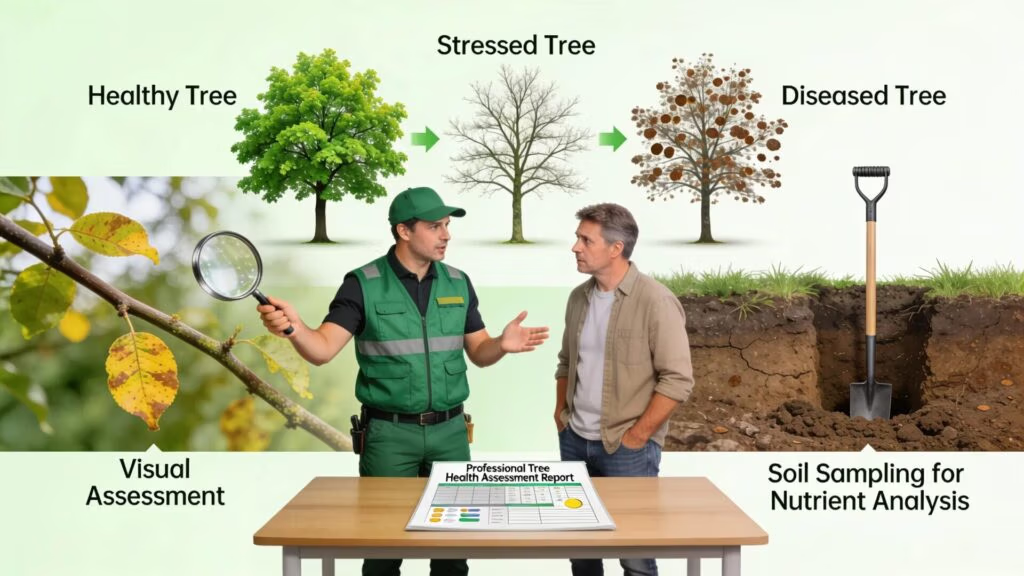
Tree health diagnosis services follow an established workflow to ensure comprehensive data collection and analysis. This workflow is designed to identify causative agents of decline and to define appropriate remediation options.
This structured sequence ensures comprehensive evaluation and generation of tailored recommendations for each individual tree.
Accurate tree disease diagnosis in Waukesha relies on identifying the vascular pathogens, insect pests, and foliar fungal diseases most commonly encountered by homeowners in Waukesha County. Typical examples are oak wilt, emerald ash borer infestation, and powdery mildew; each presents distinct diagnostic indicators and management implications.
Diagnosis commonly relies on field symptomatology, soil and tissue analysis, and, when necessary, laboratory confirmation to determine the specific pathogen or pest involved.
Local species such as oak and maple exhibit several diagnostic symptoms that warrant professional assessment. Common indicators include foliar discoloration, visible fungal fruiting bodies or cankers on bark, and bark fissures or peeling that may indicate internal decay or pest activity.
Timely recognition of these signs allows homeowners to obtain diagnostic services and implement recommended treatments to limit progression.
Early detection via professional assessments reduces the probability of irreversible decline and mitigates hazard exposure. Many pests and diseases progress asymptomatically or subtly in initial stages; regular monitoring enables earlier intervention, which typically requires less intensive treatment and yields higher success rates.
Prioritizing scheduled assessments represents an evidence-based approach to maintaining tree health and minimizing long-term liabilities for property owners.
Professional tree inspection services provide technical expertise, risk assessment capability, and documented recommendations that support informed asset management. These services contribute to hazard reduction and can preserve landscape value when applied appropriately.
Tree risk assessment cost varies according to assessment scope, tree size and complexity, diagnostic testing required, and any recommended interventions; homeowners should obtain a clear scope of work and cost estimate prior to engagement.
Homeowners should schedule “emergency tree services“ when assessments reveal conditions that present an immediate risk. Indicators necessitating urgent action include advanced structural decay, significant storm damage that compromises stability, and extensive insect infestation with imminent failure potential.
To arrange a tree health assessment with Dunbar Tree Service, contact the office by telephone at (262) 271-0189 271-0189) or by email at trees@dunbartreeservice.com. Prior to the appointment, compile information on tree locations, observed symptoms, and any previous treatments to facilitate a focused and efficient evaluation.
Dunbar Tree Service provides expert evaluations and delivers comprehensive “care plans” tailored to the specific conditions present on each property.
Certified arborists use a range of specialized tools to obtain accurate diagnostic data. Typical equipment includes hand pruners for minor corrective work, climbing and aerial access gear for crown inspection, bore scopes or resistance drills for internal decay assessment, soil testing kits for nutrient and pH analysis, and measuring instruments for recording tree dimensions and structural metrics.
For most residential contexts, an annual assessment is recommended, with increased frequency for mature, veteran, or stress-affected trees. Post-event inspections following severe weather are advisable to identify new risks introduced by storm-related damage.
During an assessment, a certified arborist conducts a systematic visual inspection for disease, pest activity, and structural defects, collects site and soil information as required, and documents findings. The client receives a report summarizing observations, diagnostic conclusions, and recommended management actions.
Tree risk assessment cost depends on the scope of the evaluation, the tree’s size and complexity, any diagnostic testing required (such as soil or tissue analysis), and the interventions recommended afterward. Homeowners should request a clear scope of work and cost estimate before engaging an arborist.
An ISA certified arborist in Waukesha holds credentials from the International Society of Arboriculture, complies with applicable occupational safety standards, and participates in continuing education covering current arboricultural practices and emerging pest and disease threats.
Treatment recommendations depend on disease etiology and severity. An arborist will propose a management plan that may include chemical control, cultural and soil amendments, monitoring protocols, or removal when the tree poses an unacceptable risk to people or property. The plan will be tailored to the specific diagnosis and expected prognosis.
Regular tree health assessments are a prudent component of property risk management and landscape stewardship for homeowners in Waukesha County. Early identification of structural defects and pathological conditions, from oak wilt to emerald ash borer, enables targeted interventions that reduce hazard exposure and preserve landscape value. Working with an ISA certified arborist in Waukesha ensures that any tree disease diagnosis in Waukesha is grounded in verified training and standardized methodology, while understanding tree risk assessment cost in advance helps homeowners plan with confidence. Engage a certified arborist to obtain a formal evaluation and a documented plan of action, and review available arborist services in Wisconsin for a detailed assessment tailored to site-specific conditions.